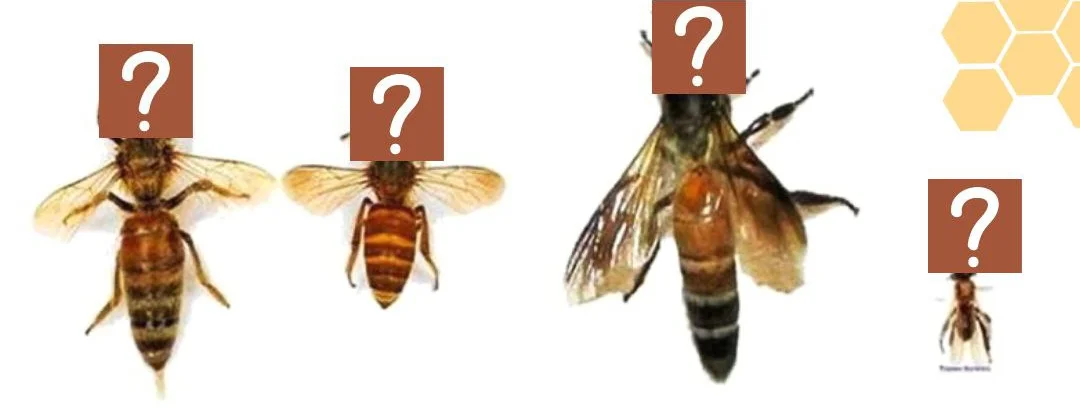
Bees are insects that play a crucial role in the ecosystem and have been known to humans for thousands of years as producers of honey. The honey they produce is not only a delicious natural sweetener but also offers various health benefits. This article will discuss the types of honey-producing bees, the honey production process, and the benefits and significance of bees in our lives.
However, before we proceed, it would be good to take a look at His words in Surah An-Nahl 68-69, where Allah Azza wa Jalla says:
وَاَوۡحٰى رَبُّكَ اِلَى النَّحۡلِ اَنِ اتَّخِذِىۡ مِنَ الۡجِبَالِ بُيُوۡتًا وَّمِنَ الشَّجَرِ وَمِمَّا يَعۡرِشُوۡنَۙ ٦٨
ثُمَّ كُلِىۡ مِنۡ كُلِّ الثَّمَرٰتِ فَاسۡلُكِىۡ سُبُلَ رَبِّكِ ذُلُلًا ؕ يَخۡرُجُ مِنۡۢ بُطُوۡنِهَا شَرَابٌ مُّخۡتَلِفٌ اَلۡوَانُهٗ فِيۡهِ شِفَآءٌ لِّلنَّاسِؕ اِنَّ فِىۡ ذٰ لِكَ لَاٰيَةً لِّقَوۡمٍ يَّتَفَكَّرُوۡنَ ٦٩
The meaning :
“And your Lord inspired the bee, ‘Build nests in the mountains, in the trees, and in the places which people have made. Then eat from all the fruits and follow the path of your Lord which has been made easy for you.’ From the bellies of bees comes a drink (honey) of varying colors, in which there is healing for mankind. Indeed, in that is a sign for those who reflect.” (Surah An-Nail 68-69)
After reading His words above, we can identify that the places where bees reside are:
In the hills: This is usually a favored spot for Apis dorsata bees (the honey produced is commonly referred to as rock honey/Madu Cadas).
In trees: This is typically inhabited by Apis cerana and Apis dorsata bees (the honey produced is usually called wild honey or forest honey). Trigona or Klanceng bees also make their habitat in wood and bamboo.
In man-made structures: Such as beehives or wooden boxes, which are usually utilized by Apis mellifera, Apis cerana, and Trigona species (the honey produced is commonly referred to as farmed honey).
Allah Subhanahu wa Ta’ala has bestowed numerous guidance upon bees, including:
The homes built by bees, whether in the mountains, in trees, or in the beehives created by humans, are very well-constructed. They are strong and sturdy, with no gaps or flaws, making it difficult for enemies to enter.
Bee Food. Bees can consume all types of fruits and flowers, producing honey according to the type of nectar they collect.
Allah Subhanahu wa Ta’ala has made it easy for bees to undertake their heavy and long journeys. They traverse vast valleys, towering mountains, and rugged terrains, then return to their hives without getting lost. Remarkably, bees can even carry their hives and honey as they move from one place to another.
Ibn al-Qayyim (may Allah have mercy on him) emphasized that bees are among the most beneficial and blessed creatures. Therefore, Allah Subhanahu wa Ta’ala has granted them special inspiration and guidance. (Shifa’ al-A’li, p. 167; see Tafsir Ibn Kathir on Surah An-Nahl: 69)
Several Types of Honey-Producing Bees
After discussing His words above, we can identify several types of bees based on their habitats, namely Apis dorsata, Apis cerana, Apis mellifera, and Trigona species. Let’s take a look at the details as follows:
Apis Dorsata

Apis dorsata, also known as the giant honey bee or Asian honey bee, is one of the largest species of honey bees found in Asia. These bees are known for their large body size, impressive nests, and their ability to produce honey in substantial quantities. This species has the following characteristics:
Size: Apis dorsata is one of the largest honey bee species, with a body length reaching 2.5 to 3 cm.
Appearance: They have a large body, transparent wings, and their coloration varies from brown to black with yellow stripes.
Nests: The nests of these bees are built openly on tall trees or cliffs and consist of honeycomb cells arranged in large layers.
Habitat: Tropical and subtropical forests in Asia, including countries such as India, Bangladesh, Thailand, Indonesia, and the Philippines. They prefer areas with dense vegetation rich in flowers as a source of nectar.
Taste and Quality of the Honey Produced: The honey produced by Apis dorsata has a distinctive flavor that differs from that of honey produced by other species. This unique taste comes from the nectar collected by the bees from various floral sources.
Apis Mellifera

This bee is the most common and widely cultivated type of honey bee throughout the world. Apis mellifera is known for its high honey production and its ability to adapt to various environments. This species has the following characteristics:
Size: Apis mellifera has a varying body size, generally smaller compared to Apis dorsata, with a length of about 1.2 to 1.5 cm.
Appearance: They have a slender body with coloration that varies between yellow and black with stripes. Their hairy (hirsute) bodies assist in pollen collection.
Nests: Their nests are usually built inside tree hollows, human-made boxes (farmed colonies), or other sheltered structures, featuring a combination of well-organized cells.
Habitat: They can be found in various habitats around the world due to their adaptability. They are often cultivated in gardens, fields, and agricultural areas, requiring access to diverse sources of nectar and pollen.
Taste and Quality of the Honey Produced: The flavor varies depending on the sources of nectar collected, which can be sweet, rich, and slightly floral. It has a smooth consistency with a high level of clarity. The quality is often influenced by processing and storage methods. The products can be extracted and marketed in various forms, including liquid honey, semi-solid honey, and comb honey.
Apis Cerana

Known as the Asian honey bee, this species of honey bee originates from tropical and subtropical regions of Asia. These bees play a crucial role in the ecosystem as pollinators and in honey production. This species has the following characteristics:
Size: Apis cerana is smaller compared to Apis mellifera, with a body length of about 1.0 to 1.2 cm.
Nests: Apis cerana typically builds its nests in sheltered locations, such as inside homes, among tree branches, or in hollows, often with nest structures that are less complex than those of Apis mellifera.
Appearance: They have a slender body with darker coloration, often ranging from brown to black. Apis cerana also features glossier wing coverings.
Habitat: Generally found in regions of Asia, they prefer tropical and subtropical forests. They are also often observed in urban and rural areas with access to abundant nectar sources from a variety of flowering plants.
Taste and Quality of the Honey Produced: The honey produced by Apis cerana has a stronger and more robust flavor, often with unique herbal or fruity notes. This taste is greatly influenced by the types of flowers in bloom and can vary significantly depending on the time and location of collection. Due to its higher antioxidant content, the honey can range in color from yellow to dark amber, with a viscosity that can be quite thick. Although the production quantity may be lower compared to Apis mellifera, its quality is often highly valued.
Stingless Bee

Stingless bees, or meliponines, refer to several bee species that belong to the genera Melipona and Trigona. They are known for lacking stingers but still possess the ability to protect their nests from predators in other ways, such as through coordinated attacks. The one we will discuss here, commonly found around us, is Trigona. This species has the following characteristics:
Size: Stingless bees vary in size depending on the species, but they are generally smaller compared to honey bees of the Apis genus.
Appearance: They have hairy bodies, often in shades of black, brown, or yellow, and possess a slender shape. Some species also exhibit interesting color patterns.
Nests: Stingless bee nests are typically located in protected areas, such as inside trees, walls, or even underground. Their nests consist of wax cells shaped like honeycomb, and they often have structures that are less complex than those of Apis bees.
Habitat: Stingless bees can be found in various habitats, including tropical and subtropical forests, as well as rural areas around the world. In Indonesia, specifically, stingless bees are found in many regions and play a crucial role in pollinating local plants.
Taste and Quality of the Honey Produced: The honey produced is often marketed as “klanceng honey” in Indonesia. This honey has a distinctive flavor and is believed to offer various health benefits. The quality of the honey produced can vary but is generally well-regarded for its unique characteristics.
That’s it, my friend! It turns out that bees vary in types and classifications, as well as in their shapes and habitats.
Therefore, the presence of bees is crucial for the environment and agriculture. In addition to producing honey, bees also serve as pollinators for plants. Approximately 75% of flowering plants rely on pollination by bees and other insects for reproduction.
The loss of bee populations worldwide has raised serious concerns as it can disrupt the food chain and the sustainability of ecosystems. Therefore, protecting bee habitats and educating the public to maintain the health of bee populations is of utmost importance